
Pet households
40 mil is the spec built for paws and claws — twice the protective layer between toenails and the floor's printed design.
Vinyl plank buying guide
Wear layer thickness — not total plank thickness — determines how long a vinyl floor keeps looking new. Here's how to choose the right spec for your home, in plain English.
Two numbers on every spec sheet get confused for each other. This page separates them, then shows you which one to buy for the way your rooms actually get used.
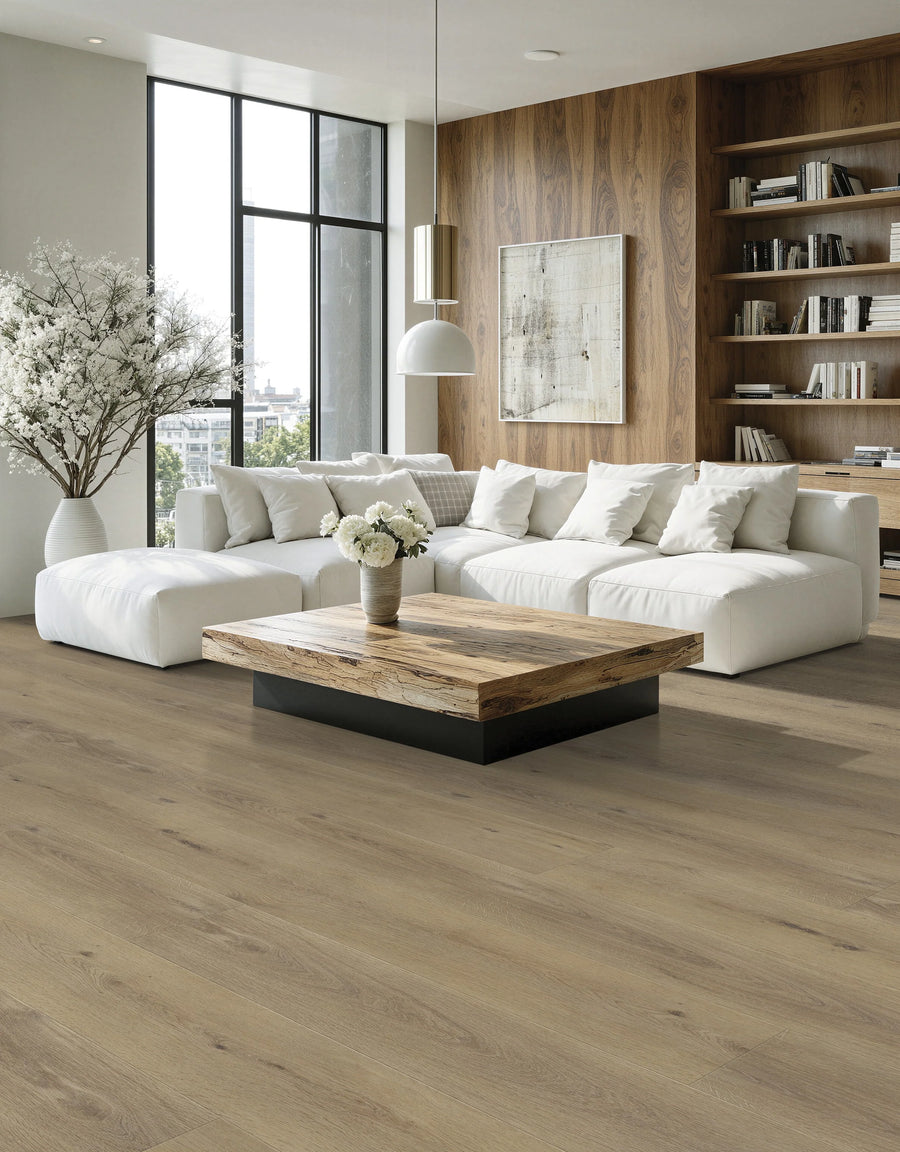
Fortis Collection — extra-wide plank with a 40 mil wear layer.
Every luxury vinyl plank has a transparent protective layer on top — the wear layer — that stands between daily life and the printed design underneath. Measured in mils (thousandths of an inch), it is the single best predictor of how a floor will look in year five, not just on day one.
A thicker wear layer resists scratches, scuffs and dulling longer. It is also why two planks that look identical in a showroom can age completely differently in a hallway.
Don't confuse the two numbers. Total plank thickness (5 mm, 7 mm) is about structure and feel underfoot. Wear layer (12, 20, 40 mil) is about longevity. The second number is the one that decides how long the floor keeps looking new.
Right tool for the job
Thicker is not automatically better — it is better for particular rooms and particular households. Here is what each step on the ladder is built for.
| Compare | 12 Mil — Entry Level | 20 Mil — The Residential Standard | 40 Mil — Commercial Grade |
|---|---|---|---|
| Best for | Light-use spaces: guest rooms, low-traffic areas | Most homes and most rooms — the proven all-arounder | Homes that live hard: big dogs, kids, entryways, rentals, forever homes |
| Traffic rating | Light residential | Full residential | Commercial and residential |
| Typical warranty | Varies by line | Residential lifetime, varies by line | Lifetime residential, 20-year commercial |
| Where we standOur position | We generally don't stock it. A thin wear layer is the first thing on a floor to show its age. | The backbone of our catalogue, and excellent value for most households. | Our Fortis Collection — twice the protective layer of the 20 mil standard. |
Most homes are well served by 20 mil. It is the standard we have sold and stood behind for years, and for typical households it delivers. But some floors work harder than others. If your entryway sees cleats, claws and cargo, stepping up to 40 mil buys you protection that used to be reserved for airports and retail stores.
40 mil against 20 mil, drawn to scale. The design layer, the core and the pad are doing the same jobs in both planks — the difference is entirely in the clear layer taking the abuse on top.
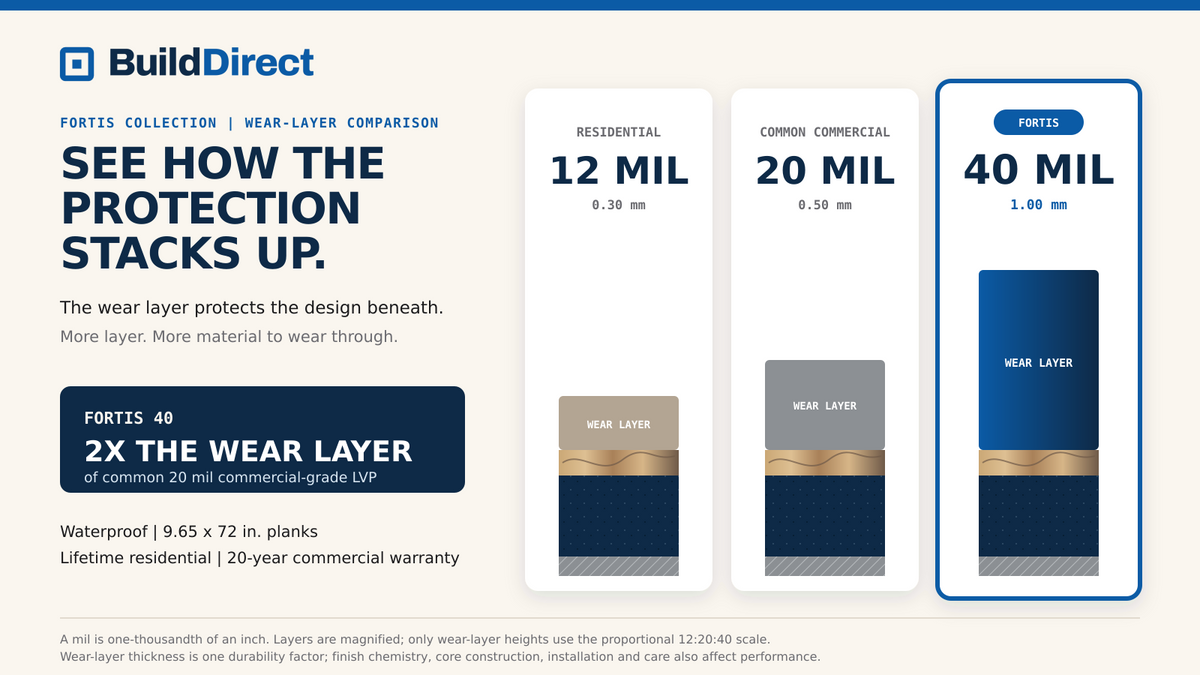
Four situations where the thicker wear layer earns its price. If none of these describe your rooms, 20 mil is very likely the right buy.
40 mil is the spec built for paws and claws — twice the protective layer between toenails and the floor's printed design.
Entryways, kitchens, hallways. The rooms that age first are the reason commercial-grade exists.
Turnovers are brutal on floors. A commercial rating means fewer replacements between tenants.
If you plan to still be on this floor in 15 years, buy the floor that will still look new in 15 years.
Introducing Fortis
A 40 mil wear layer in a residential plank has generally meant paying boutique-brand prices for it. Fortis changes that maths: the commercial-grade wear layer, on an extra-wide plank, with the acoustic pad already attached.
Best for: Homes with large dogs, heavy foot traffic or rental turnover, where floors wear out from the top down.
$4.35 / sq ft
See Fortis specs and coloursEvery specification and the price above are read live from our catalogue, so this page cannot drift out of step with the product page. Prices shown are per square foot and exclude delivery.
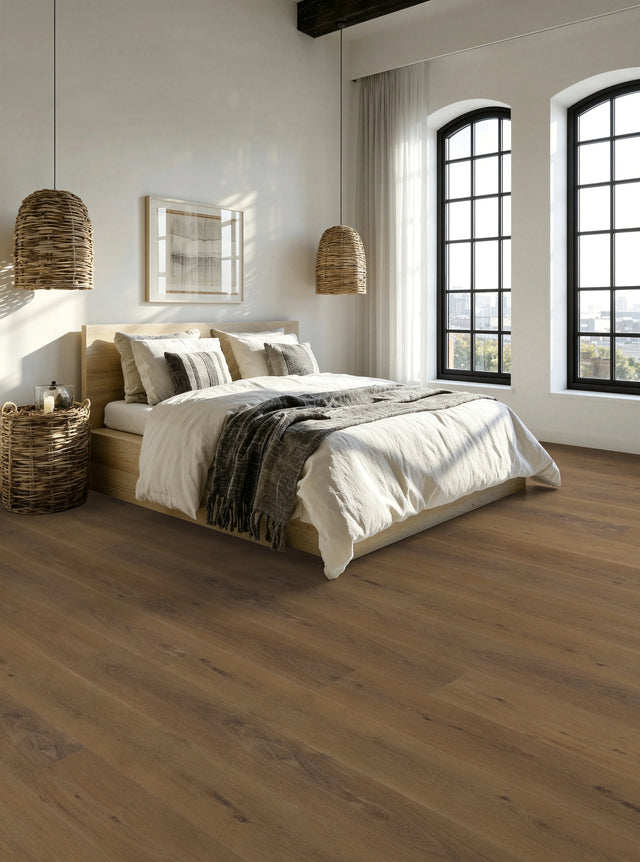
Fortis Collection in a bedroom. Illustrative room photograph.
Free expert help
Wear layer is one of four or five decisions in a flooring order, and the other ones — how much to buy, what the subfloor needs, how it gets delivered — are easier to get right with someone who does this daily. Every BuildDirect order is assigned a flooring expert.
Bring these four things to the conversation and you will get a straight answer quickly:
No appointment, and no obligation to order anything on the call.
For most rooms, 20 mil performs well for years — 40 mil earns its price in homes with large dogs, heavy foot traffic or rental turnover. Those are the situations where floors wear out from the top down rather than failing structurally. 40 mil is the same class of wear layer specified in commercial buildings rated for thousands of footsteps a day.
Usually, yes. 20 mil is the residential standard for a reason and covers typical family life. Think of 40 mil as the option for floors that work overtime, not as a warning about 20 mil.
Plank thickness affects rigidity and feel underfoot; wear layer affects how long the surface resists scratches and dulling. A 7 mm plank is not automatically more durable than a 5 mm one — longevity lives in the wear layer. Note that a published plank thickness sometimes includes an attached pad, so check whether the number you are comparing is the plank or the whole build.
Yes — it is the most pet-relevant number on the box. The wear layer is what stands between claws and the plank's printed design. No floor is scratch-proof, but a thicker clear layer is what postpones visible wear.
Yes. Fortis uses the Unilin Uniclic® click-lock system — a floating, glue-free installation that is DIY-friendly. The acoustic pad is already attached to the plank, so there is no separate underlay to roll out first.
No — Fortis is not rated for radiant heat. If you have in-floor heating, tell your flooring expert before you order and they will point you at a range that is rated for it.
One plank in your hand beats ten spec sheets
Specs are useful. Holding the plank is better — the wear layer is something you can feel with a fingernail.
