What is the Janka Hardness Scale?
|
|
Time to read 6 min
Get 5 free samples + expert help from selection through delivery. Choose samples

|
|
Time to read 6 min
The Janka Hardness Scale determines the hardness of a particular type of wood over another. The scale was invented in 1906 by Gabriel Janka, an Austrian wood researcher, and standardized in 1927 by the American Society for Testing and Materials (ASTM).
Depending on the room where the flooring will be installed, a certain level of hardness may make it a more desirable choice. Generally speaking, the higher the number on the scale, the harder and more scratch-resistant a wood is. The harder a wood is, the more difficult it becomes to saw or run through a mill. Surprisingly enough, though, this does not impact the price for flooring. Flooring prices are dictated by how readily available the species of wood is, rather than how hard it is.
The scale was developed as a means for displaying the results of the Janka hardness test. The test uses a 2″ x 2″ x 6″ piece of wood and a 0.444″ steel ball to determine how hard the wood is. The test figures out how many pounds per square inch, or PSI, of force, is needed to push the steel ball halfway into the wood plank.
When the Janka test is conducted on a specimen of wood, the results may vary slightly, depending on the grain of wood used for the test. For example, if the grain is flat, it is considered normal and is presented on the Janka scale. Though vertical wood grains are tested too, those results are not usually shown on the scale. Wood is also tested on the sides or ends because that provides a different hardness rating, but these ratings are not displayed on the typical hardness scale.
What The Wood Hardness Scale Looks Like
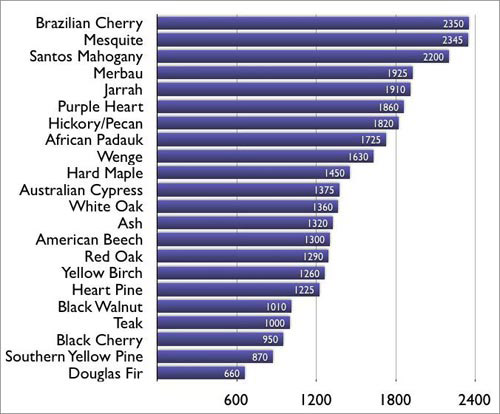
Janka Hardness Scale
The Janka Hardness Scale starts at zero, with this option being the softest wood choice, making it easy to dent and scratch. Though no wood on the scale has this rating, a rating like this would not make for a good floor. The highest rating on the scale is a 4000, making for an extremely hardwood, also not likely suitable for flooring because it would be so difficult to saw.
Oak is the most popular wood flooring choice, but where does it rank on the scale? White oak has a rating of 1360 and red oak has a rating of 1260. Other flooring types rate harder and softer than this, so what makes oak so special? Most likely it is the abundance of oak available for sawmills leading to its mass production for flooring purposes that makes it an affordable option. The more affordable something is to the general public, the more widely used it is likely to be. This isn’t to say that oak isn’t a strong wood, as oak planks are an excellent choice for homes. Going strictly by the Janka rating, there are other choices out there for harder woods.
Let’s take a closer look at hardwood and softwood in a home to demonstrate how care and maintenance play a considerable role in the appearance of floors years down the road. Consider two homes by the beach, where sand will provide the means for scratching on the floor surface.
Home A uses a softwood, such as American Cherry (950 on the Janka Scale). The owners take extreme care in cleaning the floor and keeping the sand from the inside of the home. Ten years after the installation, the flooring looks as new as it did the day it was installed. The residents of the home include children and pets, all of whom stay active. The Janka Hardness Scale may lead people to believe this would be a bad flooring choice, when in all actuality, it may be the perfect one!
Home B uses a fairly hard wood, such as Brazilian Cherry (2820 on the Janka Scale). The owners are not known for cleaning up after themselves and maintain a highly active lifestyle. Six years after the installation, the floor looks terrible and may need replacement. The Janka Hardness Scale may lead people to believe this is a better choice of flooring, simply because it is harder than its American Cherry counterpart when that’s not necessarily the case.
Choose a hardwood floor based on its look and price before anything else. The bottom line is that no matter what, wood will need to be taken care of correctly to withstand the wear of time. If it isn’t taken care of, it doesn’t matter how hard or soft it is. If a decision cannot be reached, try using the Janka rating to gauge the hardness of the wood, solely as an indicator of how well the wood will be able to stand up to furniture, pets, children, and everyday life. Softer woods don’t always mean earlier replacement and repairs, so going with look and price first is always the best bet.